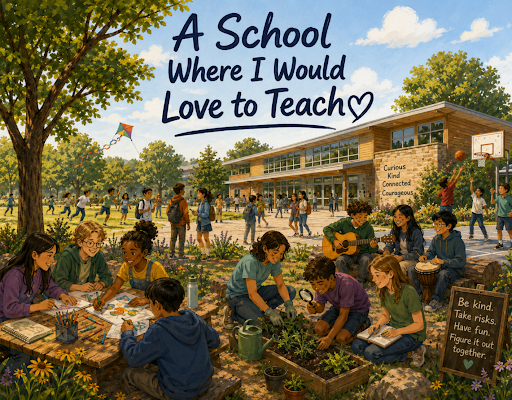
A School Where I Would Love to Teach
A School Where I Would Love to Teach
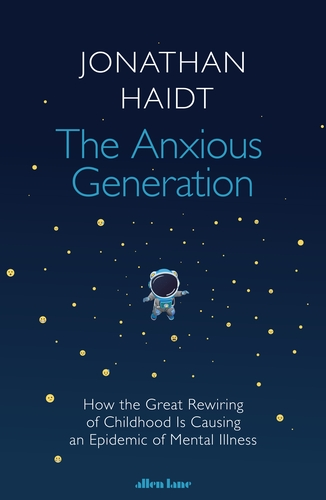
Sorry for posting two book reviews so close together, but I wanted to write about The Anxious Generation before the movie Social Reckoning comes out. Both are about the effects of phones—social media in particular—on young people. I wanted to share some of the research before we see how the movie presents the issue.
In the book’s conclusion, Haidt explains that The Anxious Generation wasn’t originally the book he intended to write. He had planned to write a book about what social media was doing to democracy. But as he began researching the issue, he became increasingly concerned about what smartphones and social media were doing to children and teenagers. That became a book of its own: The Anxious Generation.
I am planning to write a post on phones. But I’m holding off, because I want to see what happens in countries that are now trying something very different. Australia, for example, now requires social media platforms to take reasonable steps to prevent children under 16 from having accounts. France is also moving toward much stronger age restrictions. These are enormous real-world experiments, and I want to see what we learn from them.
But as a teaser, here are a few facts that are worth thinking about:
- 40% of children under 13 have Instagram. (p. 4)
- 46% of teens say they are online “almost constantly.” (p. 35)
- Young people receive an average of 192 notifications a day from the most popular social and communication apps. That’s roughly one every five minutes. (p. 135)
- And it isn’t just the kids. 17% of American parents say they are often distracted by their phones while spending time with their children. (p. 59)
One of Haidt’s observations really stuck with me: We have become so worried about the dangers of the real world that we rarely let children explore it without adult supervision. Yet at the same time, we’ve given them almost unlimited access to a very adult online world. (p. 71)
The book is divided into four parts. Part 1 presents the evidence for the decline in adolescent mental health. Part 2 shows how childhood changed through a combination of increasing overprotection and the rise of smartphones. Part 3 looks at the research about how a phone-based childhood disrupts healthy development. Part 4 looks at what we can do about it.
Much like my last book review, I’m not going to try to summarize the entire book. Instead, I want to focus on one chapter: Chapter 11, “What Schools Can Do Now.”
Because as I read it, I kept thinking the same thing: I would love to teach at this school.
A Better Kind of School
Rule Number One: No Phones.
I don’t mean a phone “ban” like we have at the school where I work, where students still have their phones with them in their pockets or backpacks. Just having the phone nearby is a distraction. Simply knowing it’s there can occupy some of a student’s attention. (p. 137-8) Students think about their phones. They wonder whether they have received a message. By letting them have it nearby, we’re asking students to ignore something filled with apps designed to keep pulling their attention back to it.
Students can’t help but sneak a look during class.
I see this constantly.
And the moment class ends? Phones come out.
I see this constantly too.
Phones interfere with learning. Period.
At this, better kind of school, there would be no phones at all.
Students would check-in their phones when they arrive at school whether it be primary or secondary school. The phones would be placed in secure, lockable storage and stay there for the entire school day. Students would retrieve them at the end of the school day.
No phones in pockets. No phones in backpacks. No checking between classes. No temptation sitting six inches away, making it harder to focus and learn.
And there would be clear consequences for breaking the rule. If a student gets caught with a phone three times, they lose the privilege of bringing a phone to school for a set period of time. Parents are contacted and are responsible for making sure the phone stays home. (I know I’m assuming parents will support the school here. Not all will. But this kind of school only works if parents, teachers, and administrators are all willing to enforce the same rules.)
There would still be some screen time at this school. Students would learn things like coding and other skills that actually require a computer. But screens wouldn’t be the default way of learning. Because interestingly, despite the enormous investment schools have made in educational technology, the evidence that more technology improves learning is surprisingly weak. (p. 267)
There is also an equity argument. Phone use and its negative effects are not evenly distributed. Children from lower-income and some racialized groups tend to spend more unsupervised time on their phones and may be more negatively affected. (p. 268)
Haidt acknowledges that some parents will argue that they need to be able to reach their child in an emergency. But he points out that a school where hundreds of students and parents are texting during an emergency may actually be less safe than one where only the adults have phones. (p. 266) And at my school, students aren’t supposed to be using their phones during a lockdown anyway. And if there is an emergency at home, every school has a secretary who knows how to reach a student at all times.
There is some evidence that phone-free schools are better. At these schools, there is more conversation, better academic performance, less drama, and a stronger sense of community. (p. 265)
Picture it.
Students talking to each other at lunch instead of staring at their phones. Walking through the halls without a screen in front of their faces. Actually talking between classes. No group chats blowing up during lunch. No social media drama unfolding between classes. And students sitting in class without constantly wondering what they’re missing online.
All those little conversations and interactions add up. Students get to know each other better. They feel more connected to the people around them. The school starts to feel more like a community.
I would love to teach at this school.
Rule Number Two: More Free Play.
In elementary school, there would be more recess, with less adult supervision. There would be a Play Club after school. So yes, I might have to be at work for a few extra minutes. I think it would be worth it.
Students need opportunities to play without adults constantly directing them. They don’t need us to solve every disagreement. They don’t need our advice and suggestions every few minutes. Sometimes, they need to figure things out for themselves.
And give them somewhere interesting to do it. Trees. Grass. Places to explore. Loose materials like ropes, boards, tires, and spare parts that they can use to build things and invent their own games.
The rule is remarkably simple: don’t intentionally hurt anyone.
Free play also gives children opportunities to develop creativity, problem-solving, and social skills. When children are having fun, they want the fun to continue. So when there’s a disagreement, they have an incentive to work it out. They must negotiate. They must compromise. They must communicate. (p. 10, 54-55, 72)
No adult needs to swoop in and solve everything for them.
At schools that have moved toward this kind of play, students are happier and kinder, and have fewer behaviour problems. (p. 270)
Picture it.
Kids building things. Inventing games. Arguing about the rules—and figuring it out. Running around outside.
I would love to teach at this school.
Is This a Utopian School?
I don’t think it is.
Isn’t this just how many of us grew up?
My generation went to school without phones. We spent more time outside. We played without adults organizing every minute or stepping in to solve every disagreement. We were given more independence and expected to handle more things ourselves.
None of this requires inventing a new kind of school.
It does require accepting a little more risk—and perhaps being a little less quick to blame schools, and perhaps not threatening legal action every time something goes wrong. Kids will fall. They will argue. Sometimes they will get hurt. We can’t give children more independence while trying to eliminate every possibility that something might go wrong.
It just requires enough people to believe that a different kind of school is possible. I know it’s possible, I lived it.
Other Suggestions
Haidt doesn’t stop with schools. He argues that addressing the decline in adolescent mental health will require changes from tech companies, governments, and parents too. (He recommends that tech companies implement stronger age verification and make accounts private by default. He recommends that governments help make this “utopian” school a reality and pass laws requiring tech companies to provide stronger protections for children online.)
And for parents…
He recommends providing a loving home with structure and routine, while at the same time trying to overparent a little less.
His advice for becoming less of an ‘overparenter’ is essentially exposure. The first time you let your child do something independently, it can be terrifying. The next time is easier.
What that independence looks like will depend on the child’s age: playing outside with other kids without constant supervision, sleepovers, walking to school with friends, camping, sleep-away camp, part-time jobs, and eventually perhaps a gap year.
And then, of course, there are the phones.
No social media before 16. If your child really needs a phone, start with a basic one. Talk openly about the risks of social media. Monitor phone use. Limit screen time. Protect sleep by keeping phones out of bedrooms at night. (p. 132)
And don’t forget your own phone. Put it down.
Most importantly, speak up. Whether you’re a teacher, a parent, or just a concerned Canadian—speak up. Ask schools and school boards for phone-free schools and more opportunities for independent play. Ask governments for stronger protections for children online. Support other parents who are trying to delay smartphones and social media.
And keep asking.
Because none of these changes will happen unless enough of us decide we want them.
Coming Soon:
- Ontario Needs Better Standardized Assessments
- Who Decides What Happens in Ontario Schools?
References:
Haidt, J. (2024). The anxious generation: How the great rewiring of childhood is causing an epidemic of mental illness. Penguin Press.
Resources for Teachers and Parents:
https://letgrow.org/: Leading the Movement for Childhood Independence: Let Grow champions childhood, helping kids build confidence, resilience, and self-reliance through independent play and real life experiences. We are making it easy, normal, and legal to encourage independence in kids. Through our free resources, tools, and programs like the Let Grow Experience and Let Grow Play Clubs, we’re helping families and schools empower our next generations.