At What Point Do We Move On? Six years later, it's time to look beyond the pandemic.
At What Point Do We Move On?
Six years later, it’s time to look beyond the pandemic.
My friend told me a story recently. One of her relatives has a son in his mid-to-late twenties. He doesn’t have a job, and he isn’t really looking for one. His mother explained it away like this:
“It’s not his fault. He just lost so much during the pandemic.”
My friend (and editor 🙂) was frustrated by that response (though I’m sure she hid it well).
People using the pandemic to explain every setback, disappointment, and struggle has become one of her biggest pet peeves. This blog post is for her 🙂.
Everyone lost something during the pandemic.
Preschoolers missed out on opportunities to socialize. Primary students lost critical years of learning to read and write. Junior students missed field trips. Intermediate students missed the opportunity to practice writing exams. Senior students missed prom, graduation, frosh week and the chance to build friendships as they began a new chapter of their lives.
None of those losses were trivial.
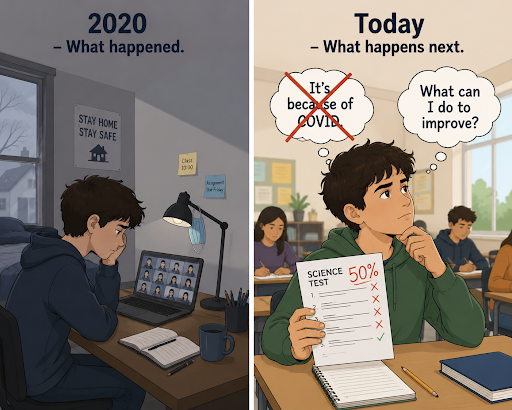
But there comes a point when it can no longer be the excuse for not getting a job, for not moving out of your parents’ house, or for not getting good marks.
At what point do we stop using the pandemic to explain every challenge we face today?
Yes, There was Learning Loss
I am not arguing that the pandemic had no effect on education. It did. There was a huge learning loss around the world. And by 2023, students had not caught up. (Betthäuser et al., 2023)
It is worth noting that the learning loss was not equal.
- Students from lower socio-economic backgrounds had the greatest learning losses. (Betthäuser et al., 2023)
- Mathematics was affected more than reading. (Betthäuser et al., 2023; Kuhfeld et al., 2020)
- Students in higher grades were more affected than younger students. (Bauer & Powell, 2025)
Yes, There was Suffering
Just as learning loss was real, so was the suffering many students experienced. Some were stuck at home with an abusive parent. Some experienced financial hardship. Some lost loved ones. Almost all were isolated from friends and family.
But this is not the first generation of young people to experience hardship. During the Second World War, British children were evacuated from their homes to escape bombing. Children who lived through the Great Depression experienced poverty and hunger. Children affected by Hurricane Katrina lost homes, schools, and entire communities.
Britain could not undo the Blitz. New Orleans could not undo Hurricane Katrina. And we cannot undo the pandemic.
The reason I mention these events is not to compare. Every generation experiences hardship in its own way.
I mention these events to show that, after every major hardship, there comes a point when we have to stop using the past as a scapegoat and move on. The world moved on after WWII, Louisiana moved on after Hurricane Katrina. We have to move on after the pandemic. Governments and school boards are still investing in helping students recover, but moving on also requires a shift in mindset from parents, students, and journalists.
The Pandemic Isn’t the Whole Story
We blame the pandemic for many of the challenges facing education today. But these challenges existed long before COVID.
- Grade inflation — evident throughout the 2010s (Sanchez & Moore, 2022)
- Chronic absenteeism — a significant problem by the 2010s (Bennett, 2025)
- Teacher workload — well documented before 2014 (Froese-Germain, 2014)
- Classroom discipline — a significant concern by 2018. In PISA 2018, Canada ranked 60th out of 77 countries and economies on the disciplinary climate index, with 38.9% of students reporting noise and disorder in most or all of their classes. (OECD, 2019)
- Declining student achievement — with Canada’s PISA math scores falling since 2003 and science scores since 2006 (OECD, 2019; OECD, 2023)
- Rising student anxiety and depression — increasing since the 2000s (Lukianoff & Haidt, 2018; Haidt, 2024)
COVID probably made some of these problems worse. It probably brought others into the spotlight. But it didn’t create them.
COVID recovery initiatives are great, but they cannot fix problems that began long before the pandemic. Governments need to figure out why all these things are happening and address the root causes. If they don’t, these issues will only get worse.
Journalists need to acknowledge that these problems have many causes and that COVID is only one of them.
And parents and students need to focus less on what happened six years ago and more on what they can do today.
Education Journalism Needs More Context
Let’s look at two recent articles.
CBC’s article, “5 Years After COVID-19 Started, Parents and Experts Say the Impact on Kids Remains”
Five years after the pandemic, the article attributes learning loss, chronic absenteeism, anxiety, and social difficulties to COVID. It never mentions that many of these challenges already existed before the pandemic or that these issues are the result of multiple factors.
CTV News article, “Students’ Skills Playing Catchup 3 Years After End of COVID-19 as Global Health Emergency.”
The article reports that students continue to struggle with reading, writing, mathematics and confidence. It attributes these challenges to the pandemic. And again, there is no discussion that many of these trends predated COVID or that they may also be influenced by other factors such as increasing screen use or changing parenting practices.
Neither article is factually wrong. The pandemic undoubtedly contributed to these challenges. The problem is that these articles and others like them oversimplify these very complex issues.
Good journalism should help readers understand the complexity of the topics presented. We rely on journalism to give us the information we need to make informed decisions. But how can we make informed decisions if we’re only getting part of the story?
We also have a responsibility as readers. When a complicated problem is oversimplified, we need to ask what might be missing.
A New Mindset
Feeling helpless during something like the pandemic is understandable. But the pandemic is over. Now, we need to help students move forward. That means helping them stop seeing COVID as the explanation for every struggle and helping them realize that what they do now matters. (Baratta et al., 2023; Brod et al., 2023; Haidt, 2024)
We have to stop letting students believe that their current struggles are the inevitable result of the pandemic. If we let them think this way, we risk teaching them that their future is outside their control.
Instead, we need to help students realize how much control they actually have over their learning. To do this, we have to challenge them. When students face challenges, persevere, and discover that their own efforts can make a difference, they gain a greater sense of control and become more resilient. They learn that when something is difficult, they can keep going and get through it. That confidence can make them more motivated and persistent and lead to better learning outcomes. (Baratta et al., 2023; Brod et al., 2023; Haidt, 2024) So, we need to raise expectations, not lower them.
The pandemic took a lot from a lot of people. That is true. But six years later, we have to be careful that COVID doesn’t become the explanation for every struggle or the scapegoat for problems that have other causes.
There will be other challenges ahead—for all of us. So, we need to teach students how to face those challenges, not how to find excuses for why they can’t.
Coming Soon:
- Students Should Know When Statistics Are Misleading
- Every Parent and Teacher Should Read This Book: The Coddling of the American Mind
References:
Baratta, M. V., Seligman, M. E. P., & Maier, S. F. (2023). From helplessness to controllability: Toward a neuroscience of resilience. Frontiers in Psychiatry, 14, 1170417. https://doi.org/10.3389/fpsyt.2023.1170417
Bennett, P. W. (2025, September 3). Canada’s student-absenteeism epidemic. Maclean’s.
Betthäuser, B. A., Bach-Mortensen, A. M., & Engzell, P. (2023). A systematic review and meta-analysis of the evidence on learning during the COVID-19 pandemic. Nature Human Behaviour, 7(3), 375–385. https://doi.org/10.1038/s41562-022-01506-4
Brod, G., Kucirkova, N., Shepherd, J., Jolles, D., & Molenaar, I. (2023). Agency in educational technology: Interdisciplinary perspectives and implications for learning design. Educational Psychology Review, 35, 25. https://doi.org/10.1007/s10648-023-09749-x
Froese-Germain, B. (2014, July). Work-life balance and the Canadian teaching profession. Canadian Teachers’ Federation. https://files.eric.ed.gov/fulltext/ED546884.pdf
Haidt, J., & Lukianoff, G. (2018). The coddling of the American mind: How good intentions and bad ideas are setting up a generation for failure. Penguin Press.
Haidt, J. (2024). The anxious generation: How the great rewiring of childhood is causing an epidemic of mental illness. Penguin Press.
Kuhfeld, M., Soland, J., Tarasawa, B., Johnson, A., Ruzek, E., & Lewis, K. (2020, December 3). How is COVID-19 affecting student learning? Initial findings from fall 2020. Brookings Institution. https://www.brookings.edu/articles/how-is-covid-19-affecting-student-learning/
Organisation for Economic Co-operation and Development. (2019). PISA 2018 results (Volume I): What students know and can do. OECD Publishing. https://doi.org/10.1787/5f07c754-en
Organisation for Economic Co-operation and Development. (2023). PISA 2022 results (Volume I): The state of learning and equity in education. OECD Publishing. https://doi.org/10.1787/53f23881-en
Sanchez, E. I., & Moore, R. (2022). Grade inflation continues to grow in the past decade. ACT.
Sumanac-Johnson, D. (2025, March 24). 5 years after COVID-19 started, parents and experts say the impact on kids remains. CBC News. https://www.cbc.ca/news
Vatterott, C. (2021, September 15). What the pandemic taught us about education (That we already knew). ISTE+ASCD.
Wright, V. (2026, May 5). Students’ skills playing catchup 3 years after end of COVID-19 as global health emergency. CTV News. https://www.ctvnews.ca/