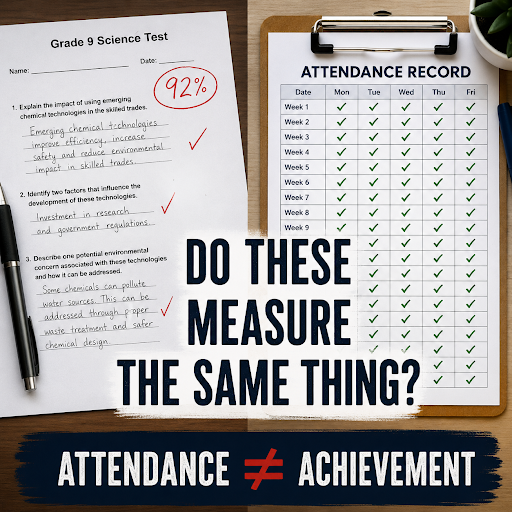
Attendance ≠ Achievement
Attendance ≠ Achievement
The Ontario government recently added an update to Growing Success—attendance will now count toward a student’s final grade.
I knew the government was considering a change. I didn’t expect it to happen so soon.
Minister Paul Calandra has said the idea of making attendance count “came exclusively from [his] engagement with teachers.” (Callan & D’Mello, 2026) Maybe he spoke with some teachers. I don’t know who they were or how many there were. But I could find no evidence of a province-wide consultation with classroom teachers, school boards, or teacher federations.
I’m not arguing that attendance isn’t a problem. It absolutely is. Students miss school for sporting events, week-long (and sometimes month-long) family vacations, field trips, birthdays, illnesses, and, yes, sometimes they just skip school. Perhaps the most frustrating situation is when students deliberately skip a test. I’ve seen many instances where a student is present for three of their classes that day but absent for the one class in which there is an evaluation.
The problem has become so bad that, in the 2024–25 school year, only about 40% of Ontario high school students met the province’s attendance standard of being present for at least 90% of their classes. (Callan & D’Mello, 2026; Van Wonderen, 2026)
Absences create challenges in the classroom. Teachers spend time catching students up, arranging opportunities for make-up tests, and writing alternate versions of assessments. But those classroom challenges aren’t the biggest problem. The real cost of absenteeism is its impact on student learning.
First, the absent student misses the curriculum. Reading the textbook or borrowing a friend’s notes is not the same as being in the classroom. Students miss the explanations, the discussions, the demonstrations, the questions that other students ask, and the opportunity to ask questions of their own.
Second, the students who come to class are affected too. When teachers have to spend time catching absent students up or re-explaining lessons, that’s time they can’t spend answering new questions, providing extra help, or reviewing homework for the students who weren’t absent.
Also, the sooner students receive feedback on a test or assignment, the more meaningful it is, because the work is still fresh in their minds. When students are absent, feedback is often delayed. Teachers cannot return marked tests and assignments until absent students have completed them, because the absent student would have an unfair advantage.
I’m glad the government is trying to address the attendance problem. But, I don’t think giving marks for attendance is the right solution.
Let’s go back to Growing Success, the document that explains how students’ report card grades are supposed to be determined.
First, it states, “The report card grade represents a student’s achievement of overall curriculum expectations.”
Then, in the September 2026 Update to Growing Success—the one that’s prompted this entire post—a new requirement is introduced: 10–15% of a student’s final grade will be based on attendance and participation.
Those two statements are fundamentally at odds with each other.
The update also explains what teachers are expected to look for:
For a student to earn a Level 4 (80–100%), the student should:
- Participate in class discussions and contribute ideas
- Ask relevant questions
- Respect the contributions of others
- Demonstrate positive leadership
- Contribute to fostering a positive classroom culture
- Miss less than 2 classes per semester
At first glance, this makes sense. But there are some serious problems.
Problem #1: The criteria are not curriculum expectations.
Let’s start with respecting the contributions of others, demonstrating positive leadership, and contributing to a positive classroom culture.
These are all admirable behaviours. But they are not curriculum expectations.
Here’s an example. One of the overall expectations in the Grade 9 science curriculum is to “explain the effects of various human activities on the dynamic equilibrium of ecosystems.”
A student could be respectful of others, contribute to a positive classroom culture, and demonstrate positive leadership every single day. But that does not show that the student has met this curriculum expectation—or any science curriculum expectation.
What about participating in class discussions, asking relevant questions, and contributing ideas?
These criteria penalize the quiet student. It reminds me of two students I taught several years ago. I’ll call them V and D.
V hardly ever spoke in class. He listened carefully, completed every homework assignment, and rarely asked a question. No, he didn’t participate much in classroom discussions. But he listened, reflected, and consistently demonstrated an excellent understanding of the material through his work.
D was the complete opposite. He asked question after question. He rarely trusted his own thinking and constantly looked for reassurance before moving on. His questions were relevant, but they were basic, often repetitive, and they were evidence that there were concepts he still didn’t understand.
Based on the criteria given, D would earn more of the 15%. But, V had a far better understanding of the curriculum.
Problem #2: The attendance problem won’t go away.
Over the years, I’ve seen absences excused for sporting events, birthdays, family vacations, as well as for illness and other legitimate reasons. Many of the single-class absences I described earlier—the ones where students miss only the class with a test or other evaluation—are later excused by a parent.
If excused absences don’t affect the attendance mark, and parents continue to excuse most absences, what problem is this policy actually solving? Many of the challenges caused by absenteeism will remain.
Problem #3: Too much is left to interpretation.
The criteria provided in the update are highly subjective.
Consider two students. Student A comes to class every day, participates, and is respectful. The teacher genuinely enjoys teaching them, but this student demonstrates only a limited understanding of the curriculum. Student B understands the material well but is frequently argumentative, complains about marks, or creates tension in the classroom.
Because the policy does not specify how the 15% should be divided among the criteria, a teacher could place substantial weight on contributing to a positive classroom culture. So, the full 15% could be awarded to Student A, and Student B could receive a much lower mark.
Second, if one student’s absence for a sporting event is excused, many teachers will feel it is only fair to treat similar absences the same way for other students. Because the policy does not specify how much of the 15% should be based on attendance alone, teachers have considerable discretion in how heavily absences affect a student’s grade.
Third, teachers know that just one percentage point could affect scholarships or university admissions. When the criteria are as subjective as these, it is easy to justify the higher mark.
These criteria require teachers to make subjective judgments about behaviours and how much each should count, rather than simply evaluating students’ achievement of the curriculum expectations.
A Better Solution
We cannot ignore the impact chronic absenteeism has on everyone else in the classroom. Education policy must balance the needs of individual students with the learning of the class as a whole. Awarding marks for attendance and subjective measures of participation is not the right solution.
The Ontario government says education should help students become knowledgeable, caring, and responsible citizens who contribute to their communities and to society. (Ontario Ministry of Education, 2009) Part of that preparation is learning the importance of showing up, meeting commitments, and being accountable to others.
Regular attendance is clearly an important part of Ontario’s vision for education. It should, therefore, be reflected in the requirements for earning a high school credit. Students participating in in-person learning should have to do two things: demonstrate the curriculum expectations and attend class regularly. For example, if a student misses more than five classes (about 6% of a semester), this student is no longer eligible to earn the credit.
This attendance requirement should apply regardless of whether an absence is excused or unexcused. An excused absence explains why a student was not there, but it does not change the fact that they missed class.
There should also be a greater use of Challenge for Credit. There are obvious exceptions, such as lab-based and technological courses where the learning depends on hands-on experience. For most other courses, if a student truly knows the curriculum, they should be able to demonstrate that knowledge through Challenge for Credit rather than simply not showing up because there is little left to learn.
I know this won’t be a popular opinion, but I think it is the more honest one.
One of the arguments against my proposal is likely to be the same argument many people have made against the government’s update: that it is unfair to some students. (Jones, 2026)
Students miss school for many different reasons: anxiety, illness, bullying, family responsibilities, and other challenges. These underlying issues—not attendance itself—are what need to be addressed.
Schools need to identify the causes of absenteeism and respond with appropriate supports. (Whitley, 2024) Unfortunately, many schools simply do not have the resources to do this. (Ramsay, 2026) Government funding should be directed toward attendance counsellors, social workers, mental health professionals, and staff who have the time to work with families, understand why students are absent, and help them return successfully.
Online learning also has a role to play. It allows students to work when they are mentally and physically able, at a pace that suits their circumstances, rather than trying to keep up with a class they cannot consistently attend.
We need to simultaneously hold students accountable when attendance becomes a barrier to learning and support students who need help. Awarding marks for attendance does neither.
Coming Soon:
- Do High Grades Still Mean High Achievement?
- Failure Isn’t the Enemy
References:
Callan, I., & D’Mello, C. (2026, April 15). Ontario high school attendance drops to 40% of target as government considers changes. Global News. https://globalnews.ca/news/11801587/ontario-high-school-attendance/
Jones, Allison. “Ontario to Make Attendance Count for Sizable Portion of High School Final Grades.” CityNews Ottawa, 14 Apr. 2026, https://ottawa.citynews.ca/2026/04/14/ontario-education-high-school-final-grades/
Ontario Ministry of Education. (2009). Policy/Program Memorandum No. 119: Developing and implementing equity and inclusive education policies in Ontario schools. Government of Ontario. https://www.ontario.ca/document/education-ontario-policy-and-program-direction/policyprogram-memorandum-119
Ramsay, J. (2026, April 22). Tying attendance to final marks in Ontario high schools won’t solve chronic absenteeism. Here’s why students are staying home. InsideHalton.com. https://www.insidehalton.com/news/tying-attendance-to-final-marks-in-ontario-high-schools-wont-solve-chronic-absenteeism-heres/article_31f48de5-9086-5d5e-aaf7-6880b2e60ea2.html
Van Wonderen, J. (2026, April 15). Only 4 out of 10 Ontario high school students meeting government attendance target. CTV News. https://www.ctvnews.ca/toronto/article/only-4-out-of-10-ontario-high-school-students-meeting-government-attendance-target/
Whitley, J. (2024, October 22). School absenteeism in Canada: Causes, challenges, and collaborative solutions. EdCan Network. https://www.edcan.ca/articles/school-absenteeism-in-canada/