Every Parent and Teacher Should Read This Book
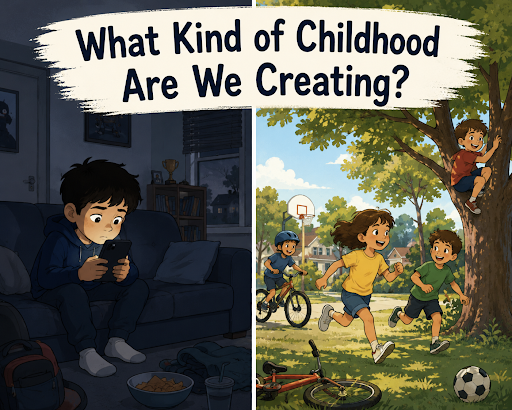
Every Parent and Teacher Should Read This Book
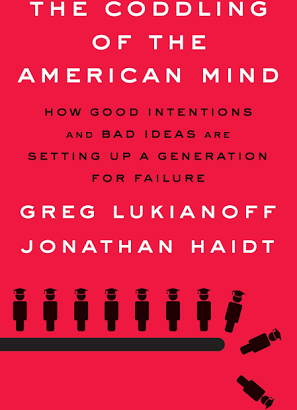
The Coddling of the American Mind
I read this book years ago, and I loved it. I reread it over the summer, and I still think it is relevant.
For years, I have noticed that children and adolescents are becoming less resilient. I thought the new style of parenting was responsible. Parents don’t want to see their children sad or struggling, so they do anything to prevent it. I have seen parents follow toddlers around so closely that the child never has the chance to fall and get back up. The soccer club gives trophies to everyone, even the losing team. And I know parents who do their child’s house-sitting job, because the child wants to go out with friends. And the child still gets the paycheque! Children aren’t getting the chance to learn resilience, to learn that they can be sad and then be happy again, that they can fail and then succeed, that they can fall and get back up.
The Coddling of the American Mind reinforced many of these ideas. So, I have to admit that one of the reasons I loved it was confirmation bias—our tendency to notice and believe information that supports what we already think. And, ironically, confirmation bias is one of the ideas the authors discuss.
Maybe for future posts, I’ll read a couple of books that argue the opposite perspective. 🙂
Now, let’s get to the book review. But I’m going to do things a little backwards and start at the end.
I’m going to focus on the practical advice in Chapter 12, because it’s the most useful part for parents and teachers. Then I’ll briefly discuss the rest of the book.
Wiser Kids - Chapter 12
Prepare Your Child for the Road
The first piece of advice is to prepare your child for the road, not the road for your child.
It reminded me of two students I taught in Grade 7, M and T. Both had ASD (Autism Spectrum Disorder) and were fairly similar in terms of their needs and academic abilities. But from the time M and T were born, their parents took very different approaches. T’s parents focused on helping him adapt to the world around him. M’s parents focused on trying to change the world M lived in. So by grade 7, T had become much more independent and integrated much more successfully with his peers.
So how can you prepare your child for the road? You need to give them what the authors call the “gift of experience.” You need to assume they are capable. Let them play unsupervised. Send them to overnight camp. Let them work out disagreements themselves. Let them bike to school or go to the park without you.
In other words, stop trying to protect them from everything.
Teach Your Child to Respond Rather Than React
A person’s response to a situation is always a choice. The authors suggest you help your child manage their emotional reactions so they can respond thoughtfully rather than simply react.
This means learning not to give in to emotional reasoning. Emotional reasoning is when you assume that because you feel something, it must be true. We all do it. But we need to recognize when we’re doing it so it doesn’t control how we respond.
To do this, first, we have to teach children that their thoughts are not always true. A simple example given in the book is that you might think it’s raining outside, but when you go look, it isn’t. (p. 242) But our thoughts can be wrong in much more complicated ways. The authors call these “cognitive distortions,” and they categorize them as follows:
- Emotional reasoning: I feel like nobody likes me, so nobody must like me.
- Catastrophizing: I’m going to fail this test, and I’ll never get into university.
- Overgeneralizing: Stuff like this always happens to me.
- Dichotomous thinking: If I don’t get an A, I’m a failure.
- Mind reading: He thinks I’m a loser.
- Labeling: I’m stupid / he’s a horrible person.
- Negative filtering: Jackie didn’t like my presentation, (even though five other people did).
- Discounting the positives: I only got a good mark because the test was easy.
- Blaming: I failed because my teacher is terrible.
Talk openly about your own cognitive distortions and let your children see how you work through them. For example, “My boss criticized how I handled a client today. I was angry and wanted to defend myself. But I waited, thought about what she said, and realized she had a point. She wasn’t attacking me. She was trying to help.”
Second, teach children and adolescents mindfulness, teach them to pay “attention in a particular way: on purpose, in the present moment, and non judgementally.” Mindfulness in children has been associated with less anxiety, healthier responses to stress, better social skills, greater empathy, and some improvements in academic performance. (p. 242) (The Child Mind Institute has some great age-appropriate resources for teaching mindfulness to children and teenagers.)
Teach Intellectual Humility
Show this by example. When you’re wrong, admit it and thank the person who helped you see something you missed. Show your child that discussions don’t have to be arguments and that the goal isn’t to win. Listen to other people. Talk through both sides of an issue so your child can hear you consider different perspectives (no confirmation bias 🙂).
Teach your child the principle of charity—to give people the benefit of the doubt, to assume most people are acting in good faith. Model this for them.
Set Limits on Technology
Set clear and strict rules about phone use. As I’ll discuss in a future post about, smartphones and social media are major contributors to rising anxiety and depression among young people.
Know what your child is doing online. The internet is an adult world, and children and adolescents should not explore it without guidance.
Protect your child’s sleep—even if they are a teenager. Have them put their devices away at least an hour before bedtime.
Let Your Child Grow Up Before Going to University
Children are growing up more slowly than previous generations. Jean Twenge’s research suggests that today’s young people reach many developmental milestones three years later (on average) than previous generations. If that’s true, we’re essentially sending 15-year-olds to university.
Your child does not have to go straight to university after high school. Many incoming students simply aren’t ready. A year spent working, volunteering or travelling can build confidence, independence, and maturity. They may get to university a year later, but they’ll be far better prepared to succeed. (Just don’t let them do nothing for the entire year!)
What Can Schools Do?
In elementary and middle school, there should be more recess and more unsupervised play. The authors describe a school in New Zealand that gave children much more freedom at recess. Instead of adults stepping in to solve every disagreement, students were encouraged to work things out themselves. Surprisingly, bullying actually went down.
Schools should be careful about how they use words like safe and safety. Physical safety is essential, but not every uncomfortable social interaction should be treated as a safety issue. Children need to learn that disagreements, hurt feelings, and occasional exclusion are part of life and that they can learn to handle these situations themselves.
There should be little or no homework in the early elementary years. That doesn’t mean filling that time with organized activities; children need time to play and explore;
All schools should be phone-free. If a student brings a phone, it should stay in the office or locker until the end of the day—not in the student’s pocket or bag.
In middle and high school, students should learn how to debate respectfully: how to distinguish evidence from opinion, support a claim with evidence, and disagree without treating disagreement as a personal attack. Readings should encourage intellectual humility—teaching students that they won’t always be right, that changing their minds in light of good evidence is a strength, and that they should challenge their own beliefs (goodbye, confirmation bias 🙂).
The Rest of the Book in a Nutshell
Part 1 introduces what the authors call “The Three Great Untruths”:
- What doesn’t kill you makes you weaker.
- Always trust your feelings.
- Life is a battle between good people and evil people.
The authors argue that the opposite is true. Children are “antifragile”—they need challenges, setbacks, and stressors to develop properly. Our feelings are not always accurate and can be distorted by the way we think. And most people are neither all good nor all evil, so we should give others the benefit of the doubt.
Part 2 looks at what happens when these three great untruths become ingrained. The chapters have titles like “Intimidation and Violence” and “Witch Hunts,” which give you a pretty good idea of where the authors think this leads.
Part 3 asks how we got here. If you only read a few chapters besides Chapter 12, I recommend Chapters 7, 8, and 9. In these chapters, the authors show that rising rates of anxiety and depression among young people are closely linked to the growth of smartphones and social media and the decline of free unstructured play.
Part 4 and the conclusion focus on what parents, schools, universities and society can do to reverse these trends. (I summarized the parents and schools part above.)
Challenge Your Own Thinking
As a teacher, I see many of the problems the authors describe every day—and I think they’re getting worse. That’s why I think every parent and teacher should read this book.
You may finish the book agreeing with every page, or you may disagree with a lot of it. But I hope it encourages you to question your own assumptions and think more deeply about how we are raising the next generation.
Coming Soon:
- A School Where I Would Love to Teach
- Ontario Needs Better Standardized Assessments
References:
Lukianoff, G., & Haidt, J. (2018). The coddling of the American mind: How good intentions and bad ideas are setting up a generation for failure. Penguin Press.