Failure Isn't the Enemy
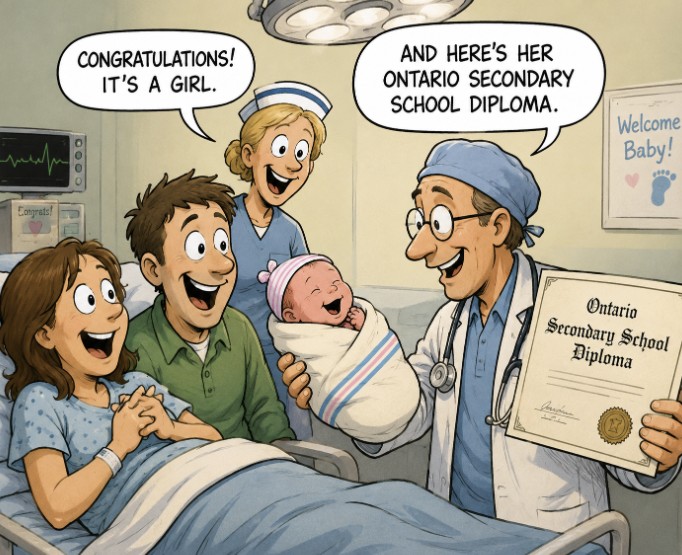
Failure Isn’t the Enemy
Every semester, I see students receive high school credits they haven’t earned.
M was one of these students.
Before the final exam, M had less than 50% in Grade 9 Science. At this point, the administration asked me what else could be done. Was there an assignment that could be accepted late? Was there a project M could redo? Could another opportunity be provided to demonstrate learning?
I can only speak for myself, but if a student is struggling, I have accepted late work, had conversations, and looked for additional opportunities to gather evidence of learning. I don’t wait until the end of the semester to do those things. Just before the exam period, I have already done everything I reasonably can to help the student earn the credit.
After the exam, when final marks were calculated, M had not earned the credit in Grade 9 Science, and I had two options: recommend credit recovery or course repetition.
Where I work, credit recovery often consists of a simple assignment that can be completed in a few hours, even if it’s spread out over two or three weeks. With AI, the student may not even have to do much of the work independently. Yet somehow, that one assignment replaces all of the learning the student failed to demonstrate during the semester.
If I believe one additional project is all a student needs to demonstrate the missing curriculum expectations, I assign it myself before the course ends. In fact, I have done exactly that with a student, L. She completed the project, demonstrated enough of the missing expectations, and earned the credit.
M was different. There were gaps across every strand of the curriculum. One assignment couldn’t possibly demonstrate everything he hadn’t learned.
I recommended that M repeat the course.
The administration asked me to change the mark and award the credit.
I did.
I didn’t like doing it. It didn’t feel honest.
And sadly, this was not an isolated incident.
Soon after, another student, N, earned 25% in my class.
She missed more than half the classes. Actually, it was probably closer to 80%.
By the end of the semester, she had written every test and submitted every assignment. I had accepted late work, met with her, and provided additional opportunities to demonstrate her learning. The evidence was complete.
She earned 25%.
Once again, at the end of the semester, the administration asked me to award her the credit. She had failed all of her classes, and they didn’t want her to become discouraged. But they weren’t asking me to bump her mark from 48% to 50%. They were asking me to raise it by 25 percentage points. That’s a lot.
I couldn’t do it.
I didn’t want her to fail, but she hadn’t earned the credit. She hadn’t demonstrated the curriculum expectations.
After deciding not to award the credit myself, I learned that by the beginning of the next school year, N had received it anyway. I was shocked. My professional judgment wasn’t the final decision, even though I was the one who had taught her, read every one of her assignments, and was qualified to assess work in the subject.
If my decision can be so easily reversed, what is the purpose of asking me to assign the final mark in the first place?
My goal is never to fail students. My goal, and I believe it should be the goal of every school, is for every student to earn the credit honestly.
If students don’t earn the credit honestly, but are merely awarded it, does it really help them?
The Consequences of an Unearned Credit
The first consequence of awarding unearned credits is that students are often unprepared for the next course.
M had the Grade 9 Science credit, but not the knowledge that credit was supposed to represent.
And that credit placed him in a classroom where he was at a significant disadvantage.
Imagine being M in Grade 10 Science. Every day, he walked into a classroom where everyone else seemed to understand what was happening, and he didn’t. Every lesson, every class discussion, and every test reminded him of everything he didn’t know.
The administration wanted to encourage him. Instead, they placed him in a classroom where he was destined to struggle.
I’m not sure that’s much of a gift.
The second consequence is that many of these students begin to believe they will pass even if they do very little work. When that happens, the incentive to work, improve, or even attend school begins to disappear.
A colleague told me about a student who was on the verge of failing Grade 10 Science. This colleague was explaining to the student what he needed to do to earn the credit. The student laughed and replied, “I don’t have to do that. Just watch—I’ll pass.”
That student had learned that he didn’t have to earn the credit, someone would give it to him eventually.
I’m not sure that’s much of a gift either.
Brian Never Had a Chance
I want to be clear: this post is about high school and earning credits, not elementary school.
Many years ago, when I was in Grade 5, there was a boy in my class. I’ll call him Brian. He had been held back the year before. He was taller and more mature. Everyone knew he had failed. He was separated from his friends and spent his days with children a year younger than him. Looking back, it was heartbreaking.
That’s why I believe younger students should stay with their peer group.
The research supports this. Students who are required to repeat a grade are more likely to drop out of high school, less likely to attend post-secondary education, and more likely to experience behavioural, social, and emotional difficulties. It has also been linked to lower reading performance, lower self-esteem, poorer school attendance, and less favourable educational and employment outcomes later in life. (Ontario Institute for Studies in Education, 2011 & OECD, 2020)
But students should not simply be passed along and forgotten. Long before they reach Grade 9, they should receive the support they need to close those learning gaps. Parents should be made fully aware when their child is not meeting grade-level expectations, and those concerns should be clearly documented as students move through the system. That includes honest report cards, including R’s when appropriate. There should be no surprises when students enter high school.
Does the Government Believe Students Shouldn’t Fail?
Ontario secondary course failures cost the education system an estimated $473 million annually. (Faubert, 2016) That’s a lot of money, so it’s easy to understand why reducing failure has become a priority. But there is an important difference between reducing failure by helping students learn and reducing failure by simply awarding credits that have not been earned.
Here’s one reason I think the government doesn’t really account for failure: look at the Achievement Chart in Growing Success.
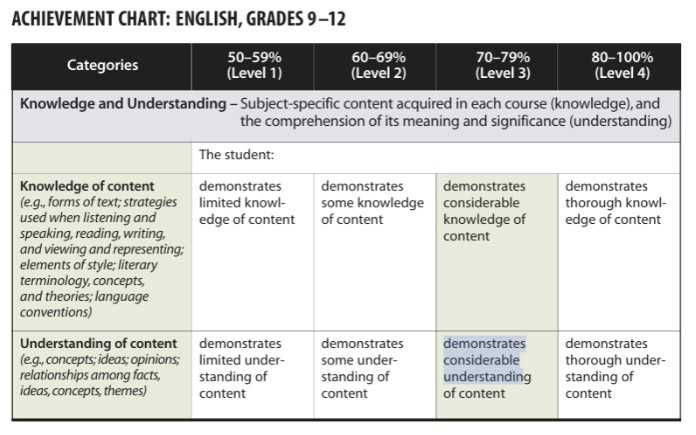
What do you notice?
The Achievement Chart describes Levels 1 through 4 but says nothing about achievement below 50%. It’s as though that level of achievement doesn’t exist. But every teacher knows it does. Students like M and N are proof of that.
More Diplomas, Less Learning?
More Ontario students are graduating than ever before. In 2004, only 56% of students earned their diploma within four years. By 2015, that figure had climbed to 78.3%, and by 2024, it had reached 84.2%. (Ontario Ministry of Education, 2016; Government of Ontario, 2025)
On the surface, this seems like a good thing. But if students are receiving credits without meeting the curriculum expectations, then a higher graduation rate does not necessarily reflect a better education.
And an educated population benefits everyone. It strengthens our workforce and supports our economy. A population with diplomas that have not been earned benefits no one.
There Is Value in Failure
An honest failure would avoid the complacency I described earlier. Students would no longer assume they will receive the credit regardless of what they do. The expectation would shift from “Just watch, I’ll pass” to “I need to work a little harder.” A failure could be the wake-up call some students need to realize something has to change—to attend class, complete their work, and seek help instead of expecting the system to carry them across the finish line.
An honest failure would also prevent students from being placed in courses for which they are not prepared. There is a reason some courses have prerequisites: a student who has not mastered Grade 9 Science is unlikely to succeed in Grade 10 Science. Repeating the course would be difficult and humbling. But sitting in a classroom every day without the background knowledge to succeed is often worse.
But it is not just about avoiding these negative outcomes. There are also real benefits to an honest failure.
The research on failure doesn’t usually examine failing an entire course. It focuses on failing while you’re learning—getting a math problem wrong, performing poorly on a test, or struggling with a difficult concept.
These failures provide feedback. They help students recognize misconceptions, identify gaps in their understanding, and adjust how they approach learning. (OECD, 2025)
Course failure is different. By the time a student fails a course, the semester is over.
But I think the same principle still applies. Honest failure still provides honest feedback. The feedback, however, is no longer about the course material; it is about learning skills. It gives students an opportunity to reflect on why they failed and return better prepared to succeed.
The goal of education is not simply to hand out diplomas. It is to help students genuinely earn them.
Where Do We Go From Here?
Ontario cannot afford to spend hundreds of millions of dollars on course failures forever. But we also can’t solve that problem by giving students credits they haven’t earned. Canada needs educated graduates, not just more graduates.
Ontario students already have many opportunities to succeed. They can earn up to 32 credits while only 30 are required to graduate, and additional options such as summer school provide even more chances to complete courses. If students are given every reasonable opportunity to succeed before they turn 18, should the expectation eventually shift? At what point does earning the remaining credits become the student’s responsibility rather than the taxpayer’s?
Our job is to help students meet the curriculum expectations, not pretend they already have.
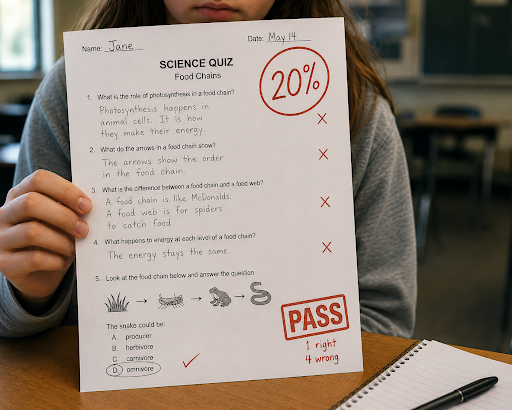
Coming Soon:
- Streaming or Destreaming? Neither.
- The Disappearing School Day
References:
Government of Ontario. (2025). 2025 Annual Report: Poverty Reduction Strategy. https://www.ontario.ca/page/2025-annual-report-poverty-reduction-strategy
Ontario Institute for Studies in Education. “Should Students Be Allowed to Fail Grades?” EdCan Network, 14 Jan. 2011, https://www.edcan.ca/articles/should-students-be-allowed-to-fail-grades/
Ontario Ministry of Education. (2016, May 3). High school graduation rate reaches all-time high of 85.5 per cent. Ontario Newsroom. https://news.ontario.ca/en/release/38710/high-school-graduation-rate-reaches-all-time-high-of-855-per-cent
Organisation for Economic Co-operation and Development. (2025). Using formative assessment and feedback. In Unlocking high-quality teaching. https://www.oecd.org/en/publications/2025/04/unlocking-high-quality-teaching_808bd876/full-report/using-formative-assessment-and-feedback_189fb6dc.html
Organisation for Economic Co-operation and Development. (2020). PISA 2018 results (Volume V): Effective policies, successful schools. OECD Publishing. https://doi.org/10.1787/ca768d40-en