Ontario Needs Better Standardized Assessments
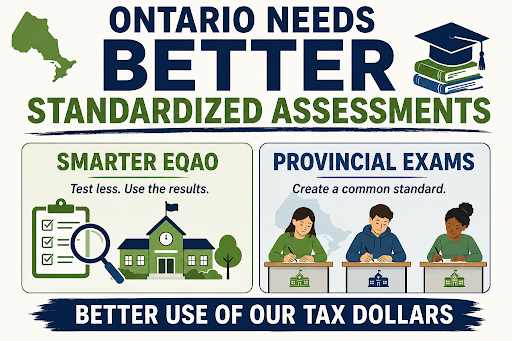
Ontario Needs Better Standardized Assessments
Build a Better EQAO
EQAO started more than 30 years ago. It costs millions of dollars per year, and it’s time to start asking whether our taxpayer dollars are being put to good use. Here are some of the problems:
- Problem 1 - Stress for Students: Testing can create stress, particularly for students who already struggle or worry about doing poorly. (OSSTF, 2018)
- Problem 2 - Teaching to the Test: Ontario teachers have reported spending more time on tested subjects and test preparation, and less on everything else. (Volante, 2007)
- Problem 3 - Monetary Cost: EQAO cost Ontario taxpayers approximately $32.4 million in 2025–2026. (EQAO, 2026 & OSSTF, 2018)
- Problem 4 - Difficult to Compare Results Over Time: EQAO has changed so much over the years that it’s difficult to tell whether scores have actually improved or declined over the long term. (Volante, 2007; YRDSB, n.d.)
- Problem 5 - Misleading School Comparisons: A school with a low score could still be a great school; it just might have more kids learning English or more families who don’t have the money for tutors, books, technology, or other educational opportunities outside of the classroom. (Volante, 2007; TDSB, n.d.)
- Problem 6 - Scores Don’t Always Show What Students Know: Some kids are nervous, don’t care, or simply don’t try—so their score may not show what they actually know. And if students in some schools are more likely to disengage than others, that can skew school-to-school comparisons even further. (Volante, 2007)
- Problem 7 - Usefulness of the Results: EQAO tells us where students are struggling, but collecting that information only has value if we use it to do something about the problems it identifies. (TDSB, n.d.; OSSTF, 2018)
Student stress and teaching to the test are not insurmountable problems, in my opinion. When I taught elementary school and the students worried about EQAO, I told them, this test is about how the school is doing, not about you. Don’t worry about it. And by Grade 9, students are going to be writing exams anyway, so learning how to prepare for and write a standardized test isn’t necessarily a bad thing. And if schools are spending excessive amounts of time preparing students for EQAO, I don’t see that as an EQAO problem. That’s a school and teacher problem.
The cost, however, bothers me—a lot. We’re spending millions of dollars every year on EQAO. What are we getting for that money?
What surprises me most is how little recent discussion I can find about this. We constantly hear about shortages of teachers, educational assistants, special-education supports, and classroom resources. Why aren’t we asking whether testing every student is the best use of tens of millions of education dollars?
I also think we’re overlooking something obvious. PISA and PCAP already give us a way to see how Ontario is doing overall. PISA lets us compare Ontario with other provinces and countries, while PCAP lets us compare Ontario with the rest of Canada. Both allow us to track performance over time. Together, they give us a pretty good picture of how Ontario’s education system is doing.
But PISA and PCAP don’t tell us how individual schools are doing. We need to know where students are struggling and where additional resources might be needed. But that doesn’t mean we need to test every grade 3, 6, 9 and 10 student in every school every year. (People for Education, 2017)
I’d test every school periodically—perhaps once every five years—and assess schools with persistently poor results more frequently.
Actually use the results. Direct the money saved to the schools that need it (and/or to provincial exams). Look at the students the school serves. Look at language, income, special education needs, attendance, staffing, student engagement and other factors that might explain the results. Then put extra staff and resources where they’re actually needed and see whether things improve.
Problems with OSSLT
The stated purpose of the Ontario Secondary School Literacy Test (OSSLT, which falls under the EQAO umbrella) is to ensure students have the reading and writing skills they need “to succeed in school, at work and in daily life.” (Ontario Ministry of Education, 2024) EQAO has also argued that the results can help identify students who are at risk and provide them with the support they need to graduate. (Sobocan, 2022)
And yet, I have to wonder how meaningful that standard really is. A friend of mine who scored the OSSLT told me that, for at least one question, the examiners were essentially instructed to give students credit if they wrote anything at all. If the bar is that low, what exactly does passing tell us?
And yet, students still fail. Who? Disproportionately, students learning English and students with special education needs. (EQAO, 2025).
For multilingual learners (MLLs), OSSLT may inadvertently measure their familiarity with Canadian culture and the types of questions used in Canadian schools, not just their literacy skills. (Cheng et al., 2007)
To me, it makes more sense to remove OSSLT as a separate graduation requirement and replace it with something more meaningful.
Students taking Grade 11 and 12 University English would complete a provincial English exam as part of their course, so their literacy would already be assessed provincially.
Unfortunately, passing an English course doesn’t necessarily mean a student is literate. Many students pass Grade 10 English and still fail the OSSLT. To ensure that they are literate upon graduation, students taking College or Workplace English would complete the OSSLT, with appropriate accommodations for multilingual learners and students with IEPs.
We would still make sure every graduate can read and write—but we wouldn’t need to give the OSSLT to every Grade 10 student in the province.
Standardized Provincial Exams
Why Provincial Exams?
-
They Create a Common Standard Across the Province
A 90% in one Ontario high school should mean roughly the same thing as a 90% in another, but research suggests that high school grades don’t always represent the same level of achievement from one school to another. (Adamuti-Trache et al., 2013) As Massachusetts Governor Maura Healey put it, “We shouldn’t have different expectations for students depending on which [postal] code they live in.” (LeBlanc, 2024) This is especially important when students are competing for the same university programs. Provincial exams would give universities a common measure of student achievement, regardless of which high school a student attended.
-
They Help Control Grade Inflation
Alberta still has diploma exams worth 30% of the final mark, and the province has largely avoided the degree of grade inflation seen elsewhere. (The Globe and Mail Editorial Board, 2026; Zwaagstra, 2026) As discussed in my post, Do High Grades Still Mean High Achievement?, universities should be able to see the classroom mark and the exam mark separately. (Zwaagstra, 2026)
-
They Make Sure the Curriculum Gets Taught
There’s another reason I like provincial exams: they can make sure the whole curriculum gets taught. Diploma exams in Alberta remind teachers that they are responsible for covering the full provincial curriculum. (Zwaagstra, 2026) Teachers can’t simply skip topics they don’t like or don’t have time for.
-
They May Better Prepare Students for University
Provincial exams may also help prepare students for university. Writing and performing well on provincial exams is associated with better performance in first-year university math and physics courses. (Adamuti-Trache et al., 2013) This is possibly because preparing for a comprehensive exam also requires students to review and bring together material from an entire course rather than simply learn one unit at a time.
Addressing the Downsides
The first concern is that students could fail the course simply because they fail the exam. I don’t think students should have to pass the provincial exam itself to pass the course. But the exam should count toward the final mark, so if the combined mark is a fail, the student fails. But a student who has done well throughout the course shouldn’t fail simply because they failed one exam. (LeBlanc, 2024)
Second is the concern that provincial exams restrict what and how teachers teach. (Adamuti-Trache et al., 2013) But I actually think the opposite can also be true. In my experience, teachers often run out of time, because more students are coming into their classes underprepared and needing extra help, so the pace of the entire class has to slow down. As a result, parts of the curriculum sometimes get left out. A comprehensive provincial exam would make that much harder to do. If students will be tested on the entire curriculum, there would be much greater pressure to make sure it all gets taught.
Third, provincial exams would create stress. I’m okay with some stress in Grades 11 and 12. I don’t think a Grade 3, 6, or 9 student needs the pressure of a high-stakes exam, but I’m only recommending provincial exams for university-level courses. Learning how to prepare for an important assessment, manage the pressure, and demonstrate what you know is part of being ready for university. The goal shouldn’t be to eliminate stress from education. It should be to make sure the stakes are reasonable and that the experience prepares students for what comes next.
—
I’m not against standardized testing. I just think we should be more thoughtful about what we test, who we test, and what we do with the results.
We don’t need to test every student every year to know how Ontario’s schools are doing. We do need to identify schools that are struggling and then actually do something to help them. And by the time students are preparing for university, a common provincial assessment makes sense. Students should know how their achievement in all university level courses compares with students across Ontario—and universities should too.
Standardized assessment should give us information we can actually use. If we’re going to spend millions of taxpayer dollars on it, we should make sure it does.
Coming Soon:
- Who Decides What Happens in Ontario Schools?
- What I’ve Seen, What I’ve Learned
References:
Adamuti-Trache, M., Bluman, G., & Tiedje, T. (2013). Student success in first-year university physics and mathematics courses: Does the high-school attended make a difference? International Journal of Science Education, 35(17), 2905–2927. https://doi.org/10.1080/09500693.2012.667168
Cheng, L., Fox, J., & Zheng, Y. (2007). Student accounts of the Ontario Secondary School Literacy Test: A case for validation. Canadian Modern Language Review, 64(1), 69–98. https://doi.org/10.3138/cmlr.64.1.069
Education Quality and Accountability Office. (2025). Ontario Secondary School Literacy Test (OSSLT): 2024–2025 provincial results. Education Quality and Accountability Office. https://www.eqao.com/wp-content/uploads/2025/10/highlights-provincial-results-2025-osslt.pdf
Education Quality and Accountability Office. (2026). Audited financial statements, 2025–2026. https://www.eqao.com/wp-content/uploads/2026/08/EQAO-audited-financial-statements-2025-2026.pdf
Genesee, F. (2007). French immersion and at-risk students: A review of research evidence. The Canadian Modern Language Review, 63(5), 655–688. https://doi.org/10.3138/cmlr.63.5.655
LeBlanc, S. (2024, November 16). More states are ditching exams as high school graduation requirements. Associated Press. https://apnews.com/article/43a8a66a16611e541355b030f77d5711
Mady, C., & Masson, M. (2018). Principals’ beliefs about language learning and inclusion of English language learners in Canadian elementary French immersion programs. Canadian Journal of Applied Linguistics, 21(1), 71–93. https://journals.lib.unb.ca/index.php/CJAL/article/view/26015
Ontario Ministry of Education. (2024). Ontario schools, kindergarten to Grade 12: Policy and program requirements. Government of Ontario. https://www.ontario.ca/document/ontario-schools-kindergarten-grade-12-policy-and-program-requirements/diploma-and-certificate-requirements-related-procedures
Ontario Secondary School Teachers’ Federation. (2018, September). OSSTF/FEESO submission to Ontario government on Planning for Prosperity. https://www.osstf.on.ca/-/media/Provincial/Documents/Resource-Centre/Briefs-and-Submissions/osstf-submission-ontario-planning-for-prosperity-sept-2018.ashx?la=en-CA
People for Education. (2017, December). Submission to Ontario’s independent review of assessment and reporting. https://peopleforeducation.ca/wp-content/uploads/2017/12/Final-People-for-Education-response-to-Ontarios-independent-review-of-assessment-and-reporting-December-2017-1.pdf
Sobocan, J. (2022). The Ontario Secondary School Literacy Test: Creative higher-order thinking? In Critical thinking education and assessment (2nd ed.). Windsor Studies in Argumentation. https://ecampusontario.pressbooks.pub/popsterscrrar2019/chapter/the-ontario-secondary-school-literacy-test-creative-higher-order-thinking/
Toronto District School Board. (n.d.). The Fraser Institute school rankings. https://www.tdsb.on.ca/research/Research/TDSB-Results-for-EQAO-and-the-OSSLT/Fraser-Institute-School-Rankings
Volante, L. (2007). Educational quality and accountability in Ontario: Past, present, and future. Canadian Journal of Educational Administration and Policy, 58, 1–21. https://journalhosting.ucalgary.ca/index.php/cjeap/article/view/42739
York Region District School Board. (n.d.). Provincial assessments. https://www2.yrdsb.ca/about-us/director-education/directors-annual-report/provincial-assessments
Extra Reading:
Ahn, C., Rickey, N., Minuk, A., Chin, J., & Luce-Kapler, R. (2025). High-stakes tests and applied learners: The (dis)connections between curriculum expectations and exam notions of “literacy.” Journal of the Canadian Association for Curriculum Studies, 21(2), 5–23. https://doi.org/10.25071/1916-4467.40823
Jones, A. (2025, December 3). Poor math EQAO results prompt Ontario to review standardized testing. The Canadian Press. CityNews Ottawa. https://ottawa.citynews.ca/2025/12/03/eqao-results-ontario-standardized-testing/
Ontario Secondary School Teachers’ Federation. (2012, June). EQAO and government standardized testing. Education Watch. https://www.osstf.on.ca/-/media/Provincial/Documents/Publications/Education-Watch/eqao-june-2012.ashx