So, What Can We Actually Do?
So, What Can We Actually Do?
Someone commented on one of my social media posts and asked what I think we should actually do to improve education. I certainly don’t have all the answers, and I won’t pretend to. I’m just a teacher who cares about education and wants people to think about these issues.
But I need to digress for just a moment. When I looked back at the suggestions I have made so far, I noticed that many of them are things I think the government needs to change. And that made me realize something else: there are some topics I have been avoiding.
Why? Because I want parents to read this blog. I want parents to think about the schools their children are attending, where their tax dollars are going, and what is happening in education. But it’s a catch-22.
Some of the problems I see in schools are, at least in part, related to parenting. And I think parents need to consider that. And, I’m not the only teacher who sees this connection. For example, here is a response to my first post on Reddit: “Students don’t know how to student. Work is optional. Parents enable this behaviour. There is no accountability. And if teachers insist on students doing the work or being held accountable for their actions, we rarely get parents’ support.”
But it takes a pretty open-minded parent to read something that challenges the way they are raising their child and seriously consider it.
That’s the catch-22. I want parents to read this blog, but I also want to be able to write about things that some parents aren’t going to agree with. Will they consider the evidence—or simply stop reading? I guess I’ll find out. 😳
Now, back to what can be done. I made a list of suggestions at the end of this post. Parents are on it, because they have a role to play in improving the education system. But, as I was hinting at above, this list is unfinished; I think there is more that parents could do. I just haven’t tackled some of those topics yet.
The list also includes things teachers, principals and universities could do. But the large majority are things that I think the government could—and should—change.
So, if a lot of these changes need to come from the government, what can everyone else do?
Tell them.
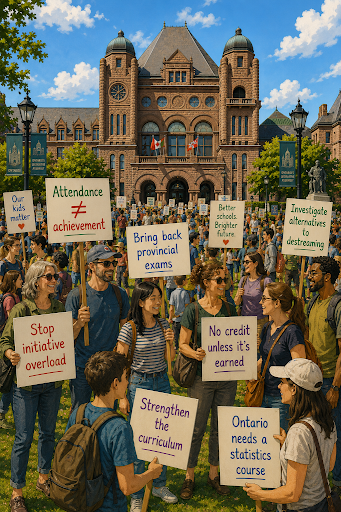
Write to your MPP and the Minister of Education. If you agree that something needs to change, tell the people who can change it. You don’t need to write an essay. Tell them what you’re seeing and what concerns you. And if you don’t know how to put it into words, send them a link to one of my posts and say, “This concerns me. I think you need to look at what is happening in our schools.”
Here is the link to find your MPP: https://www.ola.org/en/members/current
Here is Paul Calandra’s email: paul.calandra@pc.ola.org or minister.edu@ontario.ca
And finally, here are some of the suggestions I have made:
- When Does School Actually Start?
- Parents: Make school a priority. Encourage learning skills at home: Responsibility, Organization, Independent Work, Collaboration, Initiative and Self-Regulation. Make sure your child arrives prepared with the basic supplies and skills they need.
- Government: Make elementary learning skills more specific and meaningful. Write expectations that are more demanding as students get older.
- Attendance ≠ Achievement
- Parents: Stop taking your kids out of school so often. Stop excusing unnecessary absences.
- Government: Government: Don’t include attendance in the academic mark—but make attendance one of the requirements for earning the credit, regardless of whether parents excuse the absence.
- Do High Grades Still Mean High Achievement?
- Government: Introduce provincial exams for Grade 11 and 12 university level courses.
- Failure Isn’t the Enemy
- Teachers and principals: Allow students to fail when they have not demonstrated the expectations. After a certain age, require students who repeat a course to pay for it.
- Streaming or Destreaming? Neither.
- Government: Look seriously at alternatives used in other education systems, rather than treating streaming and destreaming as our only choices. Make the curriculum more rigorous and more specific.
- The Disappearing School Day
- Parents: Get students to class on time and avoid unnecessary early departures.
- Teachers: Mark students late—even when they’re only a few minutes late.
- Principals: Protect instructional time by restricting avoidable interruptions and activities during class. Rethink how guest speakers and field trips are scheduled to minimize missed class time.
- Government/school boards: Reduce the number of initiatives competing for the school day.
- At What Point Do We Move On?
- All of us: Stop using the pandemic as the explanation for everything and start raising expectations
- Government/school boards: Make the curriculum more rigorous.
- Students Should Know When Statistics Are Misleading
- Government: Create a meaningful secondary statistics course.
- Parents: Encourage students to take statistics. Discuss statistics when you encounter them in real life.
- Universities: Make statistics an entrance requirement for more programs. Statistics should be required for fields such as the sciences, health sciences, psychology, economics, political science, and other disciplines that rely heavily on interpreting data.
I don’t expect everyone to agree with all of these suggestions. That’s kind of the point of this blog. Read them. Think about them. Look at the evidence. Decide what you think.
But if you agree that something needs to change, don’t just complain about it.
Change the things you can. And for the things you can’t, tell the people who can.