Streaming or Destreaming? Neither.
Streaming or Destreaming? Neither.
This post is not what I originally imagined.
When the Ontario government first announced its plan to destream Grade 9 courses, I was convinced it was a bad idea. I worried that one teacher couldn’t possibly teach so many different ability levels well at the same time. I worried that one teacher simply couldn’t meet every student’s needs and that the very students destreaming was intended to help would fall behind.
What’s more, destreaming seemed like just another step toward lowering expectations. I worried that higher-achieving students would spend too much time waiting for the rest of the class to catch up and would not learn as much as they were capable of learning.
Applied classes did have success. As a Grade 8 teacher, I recommended Applied math or science to certain students. Those who went into Applied often did well and eventually bridged to Academic. Those who chose to take Academic despite my recommendation struggled and often ended up hating math or science.
I also believed that marginalized students were being disadvantaged long before high school, so funding and support should be directed much earlier in their education. Waiting until students were 13 or 14 and then placing everyone in the same classroom seemed less like a solution and more like an attempt to correct years of inequality after the damage had already been done.
Before researching this blog post, I had already taught several destreamed classes, and they hadn’t changed my mind. If anything, the classes I taught reinforced my beliefs. The students who needed the most support were still struggling, while stronger students were no longer being challenged enough.
But as I began reading the research, I realized there was more to the story.
I still have many of these concerns, but I no longer think the answer is as simple as keeping the old Applied classes.
Recent History of Destreaming in Ontario
It’s important to understand why Ontario adopted destreaming in the first place.
In 2019, the Higher Education Quality Council of Ontario (HEQCO) and People for Education brought together researchers, administrators, educators, students, and government representatives to look at the streaming situation in Ontario. (Pichette et al., 2020) They found that streaming posed legitimate concerns. At the time in Ontario, students were being asked to choose between Academic and Applied at 13 or 14 years old. And, when compared with students of similar academic backgrounds, students who entered Applied courses were less likely to attend university, achieved lower academically, and were disproportionately Black, Indigenous, racialized, or from lower-income families. (Pichette et al., 2020)
Ontario responded by destreaming Grade 9 Mathematics in 2021, followed by Science, English, French, and Geography in 2022. And since then, the province has invested $3 million annually to support the transition. (Ontario Ministry of Citizenship and Multiculturalism, 2025)
HEQCO hosted a follow-up workshop with educators to evaluate the implementation of destreaming. (Somji, 2023) According to participants, one of the biggest challenges was effectively teaching students with a wide range of needs in increasingly diverse classrooms. (Remember, this had been one of my biggest concerns from the very beginning.) They also pointed to the need for more timely student support and updated curriculum resources. (Somji, 2023)
That doesn’t mean destreaming was the wrong decision. But, it does suggest that implementation has been difficult.
Looking More Closely at What the OECD Actually Said
People for Education summarizes the OECD report accurately. The OECD does conclude that streaming exacerbates educational inequities, has a negative impact on students in the lower tracks, and does not improve the overall performance of the education system. (People for Education, 2023)
These concerns are well supported by the evidence. However, the OECD report says more than this.
First, when making recommendations, much of the OECD’s discussion focuses on countries that stream students at a much younger age, such as Austria, where students are separated into different pathways at 10 years old. The OECD acknowledges that it cannot recommend an exact age at which students should be streamed, but suggests that selection should occur no earlier than 15 or 16 years old. This is roughly Grade 10, which is now when Ontario students begin choosing their pathways. (OECD, 2012)
Second, it was unclear whether destreaming improved a country’s overall academic achievement as measured by PISA. Among lower-performing countries, some practised streaming while others did not. (OECD, 2020) For high scoring countries such as Singapore, Japan, and South Korea, they all have some form of streaming or academic selection during secondary education. Finally, Finland is often held up as the model for destreaming, but it is no longer among the highest-performing countries on PISA.
Third, “it is clear that streaming negatively impacts the lower levels, but it is unclear how higher achievers are impacted.” (Jakubowski, 2010, as cited in OECD, 2012) This is an important point that is often lost in discussions about streaming. Destreaming, likely negatively affects high-achieving students. This is exactly what I have seen in my classroom. The PISA results show that streaming has no effect on a country’s overall performance, but increases the inequality of performance between students. (Hanushek and Woessmann, 2006) Mathematically, if average performance remains unchanged while the gap between high- and low-achieving students decreases, the achievement distribution must become more compressed around the mean. That means gains among lower-achieving students must be balanced by losses among the higher-achieving students.
Another thing to consider is that a country’s performance isn’t solely a result of streaming or destreaming. Educational success is complex and depends on many factors. Teacher preparation, early intervention, special education services, counselling supports, curriculum, funding, and educational culture all influence student outcomes.
In the end, after reading all of the research (and I have to admit, the OECD report is not exactly thrilling literature), the point that changed my mind was this: streaming is an equity issue.
I still don’t think destreaming is the right way to address socioeconomic inequities. If students are years behind by Grade 9, we should be asking what happened in Kindergarten through Grade 8 and providing support much earlier, rather than expecting one year of destreaming to undo years of disadvantage.
But I believe every 13- and 14-year-old deserves the same opportunity to succeed. If placement in Applied classes limits a student’s future opportunities, then Grade 9 Applied isn’t giving every student a fair chance. That’s why I no longer think keeping Applied in Grade 9 is the right answer.
But there has to be a way to do this without disadvantaging high-achieving students or without lowering expectations in the curriculum. Equity and excellence should not be competing goals. Every student deserves an education that challenges them and prepares them for what comes next.
A Better Way Forward
Keep the Curriculum Rigorous—for Everyone
I agree with many of the OECD’s recommendations, including providing all students with a rigorous common curriculum. (OECD, 2012)
Unfortunately, I don’t think Ontario has lived up to that recommendation.
The chemistry unit is a good example. When Grade 9 Science was destreamed, the chemistry unit went from 15 specific expectations to just 9.
The new curriculum removes several things that used to be taught explicitly, including building molecular models, identifying common gases through laboratory tests, and comparing groups of elements on the periodic table. In their place are expectations related to sustainability. I have no problem discussing sustainability—in fact, it’s important to me, especially in a world facing climate change. But sustainability has been added to every unit in Grade 9 Science. It’s overkill. When the same message is repeated unit after unit, students eventually tune it out. And it comes at the expense of other scientific knowledge and skills that students also need to learn.
The curriculum has also become much less specific. That gives teachers more flexibility, but it also means that what students learn can vary considerably from one classroom or school to another. That’s a problem because a Grade 9 Science credit needs to represents the same knowledge no matter where a student earned it. The purpose of a provincial curriculum is to define that common foundation. It doesn’t need to dictate every lesson or every activity, but it should clearly identify the essential knowledge and skills that every student in Ontario is expected to learn.
More Recent Research Points to a Different Solution
Recent research from the United Kingdom suggests there may be another way forward.
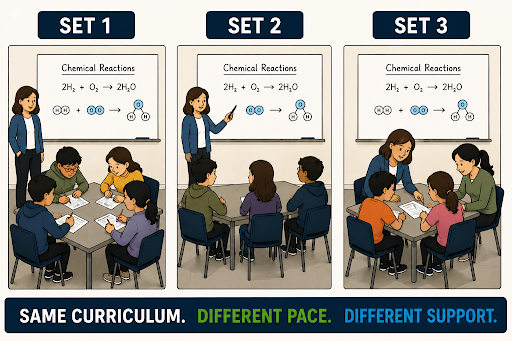
Hodgen et al. (2026) examined a model in which all students studied the same rigorous mathematics curriculum but were taught in ability-based groups. Higher-attaining groups could be larger, while groups requiring additional support could have smaller class sizes, educational assistants, or other targeted resources.
This isn’t streaming. Every student studies the same rigorous curriculum and works toward the same expectations. Students who would traditionally have been placed in Applied may earn lower marks, but they are still exposed to the same challenging concepts instead of being placed in a less demanding course. At the same time, teachers would be teaching a narrower range of student abilities, allowing instruction to be more appropriately paced and supported for everyone.
The researchers found that lower-attaining and socioeconomically disadvantaged students performed as well as similar students in traditional destreamed classes, while higher-attaining students made greater progress when taught in ability-based groups.
In other words, we could help the students who need the most support without holding back those who are ready for greater challenges.
What Conversation Should Ontario Have Now?
First, Ontario needs to strengthen the curriculum by making it more rigorous and more specific. Every student deserves a strong educational foundation for Grade 10, post-secondary education, and the workforce. And, the provincial curriculum should clearly identify the essential knowledge and skills every student is expected to learn so that a Grade 9 credit represents the same knowledge wherever it is earned.
Second, rather than choosing between traditional streaming and destreaming, Ontario should recognize that students learn at different rates and need different levels of support. Beginning in the intermediate grades, students could be taught in flexible ability-based groups while continuing to work toward the same rigorous curriculum. Instruction, class sizes, and supports should reflect those differences. This approach promotes equity for students who have traditionally been disadvantaged while ensuring that higher-achieving students continue to be challenged.
Coming Soon:
- The Disappearing School Day
- At What Point Do We Move On? Six years later, it’s time to look beyond the pandemic.
References:
Hodgen, J., Taylor, B., Tereshchenko, A., Anders, J., Jacques, L., Cockerill, M., Kwok, R., Sirl, D., Burn, H., & Bretscher, N. (2026). The Student Grouping Study: Evaluation report. Education Endowment Foundation. https://educationendowmentfoundation.org.uk/projects-and-evaluation/projects/student-grouping-study
Ontario Ministry of Citizenship and Multiculturalism. (2025). Annual progress report 2025: Ontario’s Anti-Racism Strategic Plan – Supporting children and youth. Government of Ontario. https://www.ontario.ca/document/annual-progress-report-2025-ontarios-anti-racism-strategic-plan/supporting-children-youth
Organisation for Economic Co-operation and Development. (2012). Equity and quality in education: Supporting disadvantaged students and schools. OECD Publishing.
Organisation for Economic Co-operation and Development. (2020). PISA 2018 results (Volume V): Effective policies, successful schools. OECD Publishing. https://doi.org/10.1787/ca768d40-en
Pichette, J., Deller, F., & Colyar, J. (2020). Destreaming in Ontario: History, evidence and educator reflections. Higher Education Quality Council of Ontario. https://heqco.ca/pub/destreaming-in-ontario-history-evidence-and-educator-reflections/
Somji, I. (2023). Learning from educator experiences with Grade 9 destreaming supports and strategies. Higher Education Quality Council of Ontario. https://heqco.ca/