The Disappearing School Day
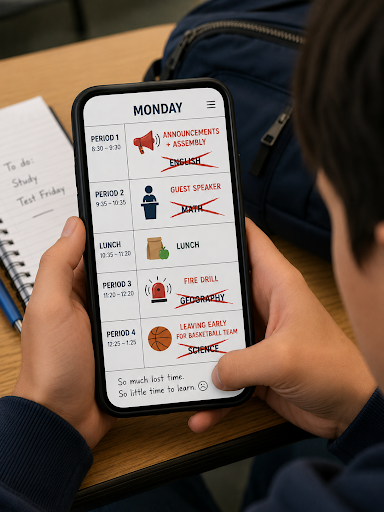
The Disappearing School Day
I used to teach in an elementary school.
One of the reasons I transferred from elementary to high school was that every year, I seemed to have less and less time to actually teach.
I thought high school would be different.
I couldn’t have been more wrong.
It seems that it doesn’t matter whether you’re teaching elementary school or high school. It seems that teachers at every grade level share the same frustration. Moore describes it well:
I really struggle with anything that interrupts class time (this also includes announcements, drills, field trips, early releases, etc.). Yes, yes, yes, I understand that all of those items have a value, a purpose, and a place. Nevertheless, I struggle with anything that cuts into instructional time. (Moore, n.d.)
I feel exactly the same way. Every interruption has a purpose and may be worthwhile. But each one competes for class time. And every minute spent on something else is a minute that students are not learning the curriculum.
The PA System and the Classroom Phone
Some interruptions are unavoidable. Others are simply habits that schools have developed over time.
When I taught elementary school, there was one afternoon announcement about bus changes that lasted nearly 20 minutes. It was literally a list of students and the buses they would be taking home. For one-third of a class period, teaching simply stopped. The students were so bored, they weren’t even listening. I wasn’t even listening.
In my high school classroom, the biggest interruption isn’t the intercom, it’s the phone. It rings constantly. A student is being called to the library to return a book. Another is needed in Student Success. Someone is wanted in the office. Guidance wants to see a student. Occasionally, someone simply wants to discuss a student with me—while I’m teaching!
Research suggests many of these interruptions are avoidable. Some schools experience far fewer interruptions than others. It may be helpful to establish clear school-wide expectations about when intercom announcements, phone calls, and classroom visits are appropriate, protecting instructional time. (Kraft, 2020)
Late Arrivals
Students arriving late to class were the most common source of classroom interruptions. (Kraft, 2020)
These interruptions do more than briefly pause a lesson. They disrupt students’ attention, derail lesson plans, and often force teachers to reteach material. The problem doesn’t end when the interruption ends: teachers lose their train of thought, students mentally disengage, and the lesson rarely resumes with the same momentum. (Barton, 2023)
It is estimated that these seemingly small interruptions cost students between 10 and 20 days of instructional time each year. This is “enough time to categorize every student … as truant or even chronically absent.” (Kraft, 2020)
Parents, prior to reading this post, you may not have realized that dropping your child off late doesn’t just affect them—it affects everyone in the classroom. So, now that you know. Please make every effort to ensure they arrive on time.
Being a few minutes late may not seem like a big deal, but when it happens repeatedly across hundreds of students and thousands of classes, the lost learning time is enormous. Even if your child misses only the national anthem or the morning announcements, the rest of the class is ready to begin when these end. Every late arrival interrupts that momentum.
High school students are old enough to get themselves to school and to class on time. Parents should expect it, schools should expect it, and students should be held accountable when it doesn’t happen.
I once had a student say to me, “My mom is annoyed that you keep marking me late.” My response was, “Then stop being late.”
Parents, if your child is repeatedly late without a legitimate reason, please make sure there are consequences at home too. Being on time is their responsibility.
And teachers, mark students late—even if it’s only by a couple of minutes. If we don’t record lateness accurately, parents may not even know it’s happening.
Guest Speakers, Field Trips and Sporting Events
Field trips have value. Guest speakers have value. Sports have value. There is no argument there.
In elementary school, field trips are usually less disruptive, because an entire class attends together. Teachers build lessons around the experience so it is intricately tied to the curriculum.
High school is different. A field trip may support learning in one course, but it often comes at the expense of two or three others.
I am not suggesting that schools eliminate field trips or guest speakers. Quite the opposite. These experiences enrich students’ education in ways that a classroom sometimes cannot, but high schools should organize them more thoughtfully.
Rather than scattering events throughout the semester, I would designate one field trip day and one guest speaker day each semester. Students could choose the field trip or presentation that best matches their interests, while the rest of the semester would be protected for uninterrupted learning.
Athletics present a similar challenge. At my school, three or four students may leave during the last period to travel to a game. During tournament season, some students miss multiple days of classes. Many participate on more than one team, drastically increasing the amount of instructional time they miss.
Some may argue that school sports are the only opportunity some students have to participate in organized athletics. And for some students, that may be true. But the majority of students on school teams also participate in sports outside of school.
I am not arguing that students shouldn’t play sports. Athletics teach teamwork, leadership, perseverance, and discipline. And, they are an important part of school life.
But as with guest speakers and field trips, I think we should organize athletics more thoughtfully. Limit the number of teams on which a student can play (for example, one per season). Limit the number of tournaments each team attends. Schedule intramural games after school rather than during instructional time.
Field trips, guest speakers, and athletics all have value, but they also come at a cost. As I discussed in Attendance ≠ Achievement, every absence represents missed learning regardless of whether this is for a doctor’s appointment or a team sport or a field trip.
Every hour spent away from class is an hour that cannot be spent learning the curriculum. Schools should recognize that trade-off and look for ways to minimize the impact on instructional time whenever possible. A more coordinated approach could also reduce the need for supply teachers teams, saving money that could be redirected toward student learning.
School Board and Government Initiatives
Schools today are expected to do far more than teach the curriculum.
Teachers are asked to address anti-racism, mental health, Indigenous education, digital citizenship, financial literacy, artificial intelligence, manners, character development and countless other priorities. Some of these initiatives come from the Ministry of Education and others from school boards. Changing societal expectations have expanded what schools are expected to do.
None of these initiatives is the problem. They all have value. They all deserve attention.
But it’s just too much.
Researchers have described this as initiative overload. (Perkins, 2011)
And when new initiatives are continually added without increasing time or resources, none of them receives the attention it deserves. (Krulder, 2024)
Let’s look at a couple of examples.
Teachers in Ontario describe Daily Physical Activity (DPA)—the requirement to provide students with regular physical activity during the school day—as one more responsibility added to an already full curriculum (Martyn et al., 2022), and report that it is often not implemented every day. (Martyn et al., 2022) Maybe it should be scheduled during recess, before school, or at another designated time rather than competing with classroom instruction.
Another worthwhile initiative is community building—taking time to get to know students and helping students get to know one another. It reflects a broader expectation that schools should foster belonging and positive relationships, not just academic learning. Many teachers now spend much of September on these activities. One student told me in October that my class was the only one in which they had actually learned anything that semester. In their other classes, they said they had been playing icebreakers, participating in team-building activities, and completing “get to know you” questionnaires.
Adding worthwhile initiatives without adding time means something else must give. Too often, that “something” is the curriculum. School boards cannot make everything a priority. They need to choose. Focusing on one or two major initiatives each year would give those initiatives the time and attention they deserve while protecting instructional time.
What I’m NOT Saying
I’m not saying “eliminate guest speakers,” “ignore mental health,” “stop athletics” or “cancel field trips.”
I am not arguing that these activities should disappear. Within reason, guest speakers, field trips, sporting events, and school initiatives all enrich students’ education. My concern is simply that they have grown to the point where they are consuming too much instructional time.
What I Am Saying
In my first post, I argued that the curriculum effectively doesn’t begin until three weeks into the semester because so much time is spent teaching students how to be students. Unfortunately, those aren’t the only weeks we lose. Throughout the rest of the school year, instructional time continues to disappear—one interruption, one initiative, and one missed class at a time.
And I haven’t even touched on the time teachers spend managing behaviour or policing cellphones. Those are important conversations, but they’ll have to wait for another day.
What it comes down to is that we are losing too much instructional time.
Every interruption may be worthwhile. Every initiative may have value. Every field trip, guest speaker, and sporting event may enrich students’ education. But time is finite. Every minute spent on one priority is a minute that cannot be spent teaching the curriculum.
If we truly want students to learn more, we don’t necessarily need more initiatives or a new curriculum.
Teachers need more time to teach. Students need more time to learn.
Coming Soon:
- At What Point Do We Move On? Six years later, it’s time to look beyond the pandemic.
- Students Should Know When Statistics Are Misleading
References:
Barton, Craig. The Cost of Classroom Interruptions. Eedi Newsletter, 16 May 2023, https://craigbarton.substack.com/p/the-cost-of-classroom-interruptions.
Kraft, M. A. (2020, June 1). The hidden cost of classroom interruptions. ASCD. https://ascd.org/el/articles/the-hidden-cost-of-classroom-interruptions
Krulder, J. (2024, June 18). Avoiding initiative fatigue. Edutopia. https://www.edutopia.org/article/teachers-manage-initiative-fatigue
Moore, K. (n.d.). Assemblies 411: How to enjoy assemblies with your students. Moore English. https://moore-english.com/assemblies-411-how-to-enjoy-assemblies-with-your-students/
Martyn, L., Bigelow, H., Graham, J. D., Ogrodnik, M., Chiodo, D., & Fenesi, B. (2022). A mixed method investigation of teacher-identified barriers, facilitators and recommendations to implementing daily physical activity in Ontario elementary schools. BMC Public Health, 22, 1986. https://doi.org/10.1186/s12889-022-14359-3
Perkins, A. (2011, February 1). Initiative overload? The Collaborative for Teaching and Learning. https://www.ctlonline.org/initiative-overload/