When Does School Actually Start?
When Does School Actually Start?
Well, here we go. My first post.
One of the first suggestions I received about blogging was: start with something shocking, get people hooked.
And I could do that.
I could tell you about the Grade 11 student who ate her test so she wouldn’t have to hand it in.
I could tell you about the Grade 9 student who repeatedly asked his teacher what mark he received on an assignment he had never submitted. When she explained that there was no mark because there was no work to assess, he genuinely could not understand. He had never encountered the idea that if you don’t do the work, there is no mark to give.
Those stories are surprising. They are frustrating. They are shocking. And I have many of them.
But those stories are symptoms of a much larger problem, and I didn’t start this blog to shock people.
So, why did I start it? At first, I really just needed somewhere to vent. I didn’t expect anyone to read it, or maybe just a handful of teachers who feel the same way I do.
But I’ve started to hope that sharing what I have seen, what I have experienced, and what I believe is happening in our classrooms might lead to something. I’m not even sure what that “something” is.
What I do know is that today’s students will become tomorrow’s nurses, electricians, engineers, teachers, and citizens. Their education matters to all of us. But I don’t think many people realize what today’s students are—and aren’t—learning in school.
Maybe the “something” is just helping more people see what’s really happening in our schools. Maybe it’s helping more people recognize the problem. Recognition is the logical first step, before we can start to fix it.
So instead of starting with the stories that grab attention, I’m going to start with the moment that finally pushed me to stop complaining about these issues to my family and friends and start writing about them publicly.
At the end of every school year, my science department has a short meeting for each course. Since I will be teaching Grade 9 Science, I attended the Grade 9 Science meeting.
These meetings tend to be repetitive, similar from year to year. I admit I was half asleep and not expecting much.
Our department head started the meeting by saying that this past year’s Grade 9 students were noticeably less prepared than in previous years. Sadly, I wasn’t surprised.
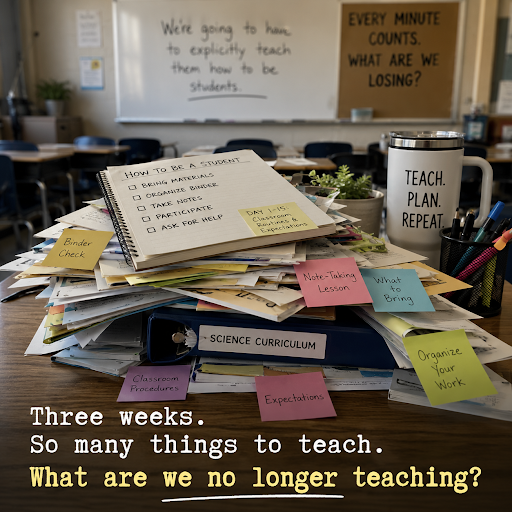
The solution? We are going to have to explicitly teach the Grade 9 students how to be students: what to bring to class, how to organize a binder, how to take notes, how to behave.
That may sound hard to believe, but it’s what I’ve been seeing in my own classroom. The last time I taught Grade 9, I helped three students empty and reorganize their backpacks because they couldn’t find their notes. Inside the backpacks were crumpled papers from four or more subjects all mixed together. In some cases, papers from the previous semester were still there. Not one of the three students had a pencil case.
In my opinion, Grade 9 students should already have the skills we are going to be teaching. Many take on part-time jobs, take the bus independently, babysit younger children, etc. It is not unreasonable to expect them to come to class prepared, to organize their materials, and to take basic notes.
Unfortunately, just because I think they should be able to do these things, doesn’t change the fact that many of them cannot. It does not change the reality we were facing.
Trying to further the discussion, the department head asked the group: “How long will it take to teach these skills?”
The answer: about three weeks.
Then came the inevitable: “What are we going to take out of the curriculum to make room for this?”
My heart sank. Less time for students to learn the curriculum. Again.
So what does Ontario actually expect when it comes to the curriculum? What does Ontario actually expect teachers to teach and students to learn? The answer is found in the Ministry of Education’s Growing Success document:
- …together, the overall and specific expectations represent the mandated curriculum – the content standards…
- …all curriculum expectations must be accounted for in instruction and assessment…
These statements make it clear that teachers are expected to teach all of the curriculum expectations, and students are expected to learn them.
The problem is this: if three weeks are spent teaching students how to be students, those three weeks have to come from somewhere. The amount of instructional time hasn’t increased. The expectations haven’t changed. That means the time available to teach the curriculum has decreased. As a result, students have less time to learn it.
So, in answer to the title question, for the curriculum, school effectively begins three weeks into the semester. Three weeks of curriculum learning lost.
And this wasn’t the first time the curriculum had been squeezed to make room for something else. Over the past ten years, students have gradually had less and less time to learn what they are expected to learn.
I remember hearing one teacher say something along the lines of: “In French, we used to teach five units. Now I’m lucky if I get through three.”
The result is that students graduate from high school with less knowledge than previous generations, because some expectations aren’t taught at all, while others are glossed over.
My children graduated from the same school years ago. They had more than sufficient general knowledge—knowledge about the world, history, science, etc. From what I see in my classroom, the educational system is not providing today’s graduates with the same foundation.
Of course, my experience is only one teacher’s experience—and one parent’s experience. On its own, it doesn’t prove anything.
But sadly, it isn’t just my experience. International assessments tell a similar story. According to the OECD’s PISA 2022 results, Canadian students’ mathematics and reading scores declined compared with previous assessments, continuing a negative trend that began before the pandemic.
This reality is not just frustrating. It is heartbreaking.
There are students sitting in my classroom who are capable of achieving so much more. They are curious. They are motivated. They have the learning skills to succeed. They don’t need me to help them be successful Grade 9 students. But every year, more time is spent filling the gaps for their peers. Gaps that should have been addressed earlier, leaving students with fewer opportunities to learn, explore, and understand the world around them.
It leaves me feeling like I am failing my students—not because I don’t care, and not because I am not trying, but because the reality of today’s classroom makes it harder and harder to teach the curriculum as it was intended.
I don’t think anyone would argue that students need to know how to organize themselves, take notes, keep track of their work, and come to class prepared.
But these are skills that have traditionally been developed over time—at home, in elementary school, and throughout a student’s education. (I want to be clear here: I am not blaming elementary teachers. I have taught Grade 7 and 8 myself, and I know the challenges they are facing. They are dealing with many of the same issues, within the same system.)
The question is not whether these skills should be taught. It is who should be teaching them, when they should be taught, and at what cost. In the current system, when those skills are not in place by Grade 9, high school teachers are left with an impossible choice: We can spend valuable class time teaching students the skills they need in order to learn, knowing they will have less time to learn the curriculum. Or we can move ahead with the curriculum, knowing that many students lack the foundational skills needed to fully engage with it.
Neither option serves students well. Either the students who need additional support don’t get enough of it, or the students who are ready for more have less opportunity to reach their full potential.
The choice my school has made is to spend valuable class time teaching students the skills they need in order to learn, so the students who are ready for more have less opportunity to reach their full potential.
Every new responsibility added to the classroom has consequences.
Time is not unlimited. Something always has to give.
My concern is that, little by little, what we’re removing is the very knowledge and understanding students come to school to gain.
Every year, the loss may seem small. But over time, those losses add up.
As Canadians, these students are the future. As parents, we want them to succeed not just at school but in life.
Why are we accepting this?
Coming Soon:
- Attendance ≠ Achievement
- Why Are Grades Rising While Achievement Is Falling?
Learn More:
Growing Success:
Ontario Curriculum:
PISA 2022:
PISA 2022 (Canada):
More academic type reading:
Similar problems in the UK: